LOCAL SEO
How Long Does a Blog Take to Rank on Google? What My Own Posts Show
Short answer
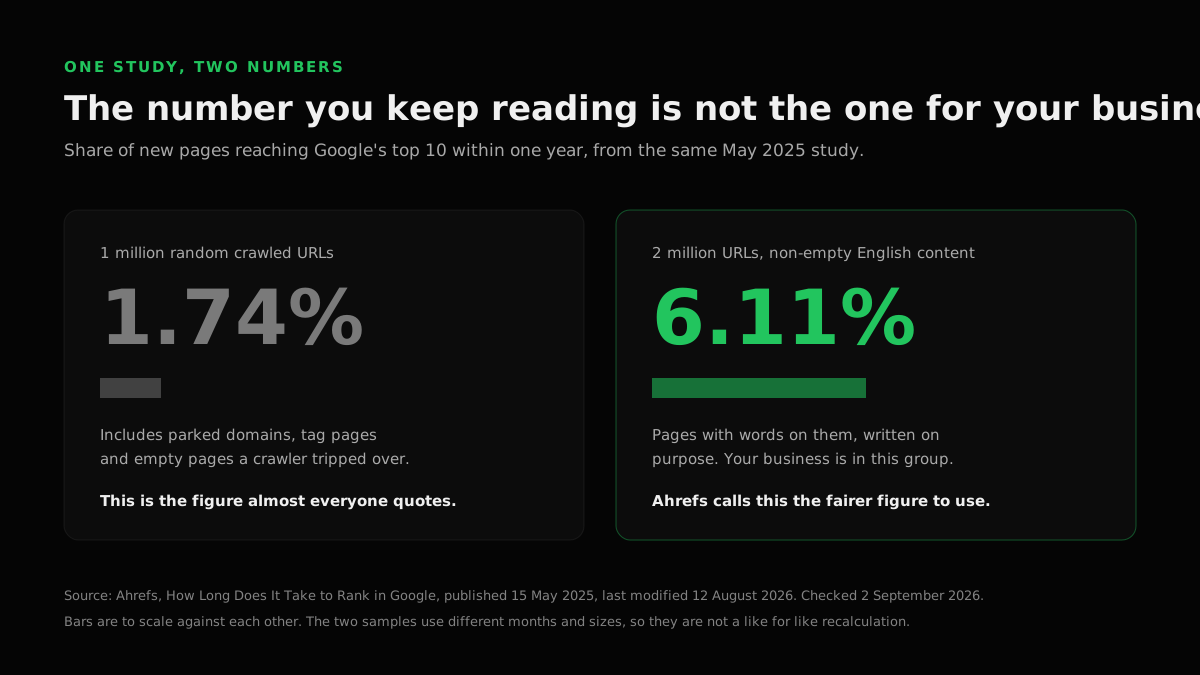
Most new pages never reach Google's top 10. Ahrefs tracked 1 million URLs and found 1.74 percent got there within a year. Filtered to real English content, 6.11 percent did, and Ahrefs itself says that may be the fairer figure. Almost nobody quotes it. The average number one page is now 5 years old, so plan in years.
A page currently ranking for this question, published in April 2026, tells you that only 5.7 percent of pages reach Google's top 10 within a year, and that number one pages are around 950 days old. It credits Ahrefs. Both figures are real. Both are from the 2017 version of the study. Ahrefs replaced them in May 2025 with 1.74 percent and an average number one page age of 5 years.
That is a thirty second check anybody can run, and it tells you how this topic works. The number gets copied from article to article long after the people who published it moved on. So here is the current study, read directly, including the part of it that almost nobody prints.
How long does a blog post take to rank on Google?
Longer than you want, and for most pages it never happens. Ahrefs took 1 million random URLs their crawler first saw in September 2023 and checked whether any reached the top 10 within a year. 1.74 percent did. 98.26 percent did not.
Of the small group that did make it, 40.82 percent got there within the first month. That sounds encouraging until you read it properly. It does not mean a month is typical. It means that if a page is going to rank, it often shows early, and a page sitting nowhere after six months is unlikely to move without changes. Ahrefs says exactly that, and recommends updating the content at that point rather than waiting.
Source: Ahrefs, How Long Does It Take to Rank in Google, published 15 May 2025, last modified 12 August 2026. Checked 2 September 2026.
Why does almost everyone quote the wrong number?
Because the study contains two figures and only one of them travels. The 1.74 percent comes from random crawled URLs. That population includes parked domains, tag archives, empty pages and every other piece of debris a crawler picks up. Your business is not in that population.
Ahrefs ran it a second way. Two million random URLs created in October 2023, restricted to non-empty English content, and 6.11 percent of those reached the top 10 within a year. The study says in plain words that this might be a more fair number to use.
It is roughly three and a half times the number everyone repeats, it comes from the same authors in the same article, and I could not find it in most of the pages ranking for this question. Ahrefs own roundup of SEO statistics for 2026 lists 1.74 percent without it.
What non-empty English content actually means
It means a page with words on it, in English, that exists on purpose. A roofer publishing a real article about permit timelines is in that set. A random URL a crawler tripped over is not. If you are choosing which figure describes your situation, 6.11 percent is the honest one, and it still means the overwhelming majority of pages do not reach page one in their first year.
What my own blog looks like six months in
I would rather show you mine than tell you about somebody else's. This is every blog page on my site with Search Console data, pulled on 2 September 2026. The property has data from 2 March 2026, so this is about six months.
| Post | Impressions | Average position |
|---|---|---|
| video-marketing-for-contractors | 311 | 14.7 |
| instagram-reels-for-business | 214 | 17.4 |
| social-media-for-event-venues | 90 | 14.0 |
| social-media-management-for-small-business | 50 | 27.9 |
| social-media-for-auto-shops | 34 | 30.4 |
| what-is-aeo | 24 | 31.3 |
Google Search Console, ru4reelz.com blog pages, 2 March to 31 August 2026. Blog pages returned 723 impressions and 1 click over the period. No page reached the top 10.
723 impressions. One click. Nothing in the top 10, and the best average position on the whole blog is 14, which is page two. The two posts I published after 12 August returned no data at all, because they are too new to have any.
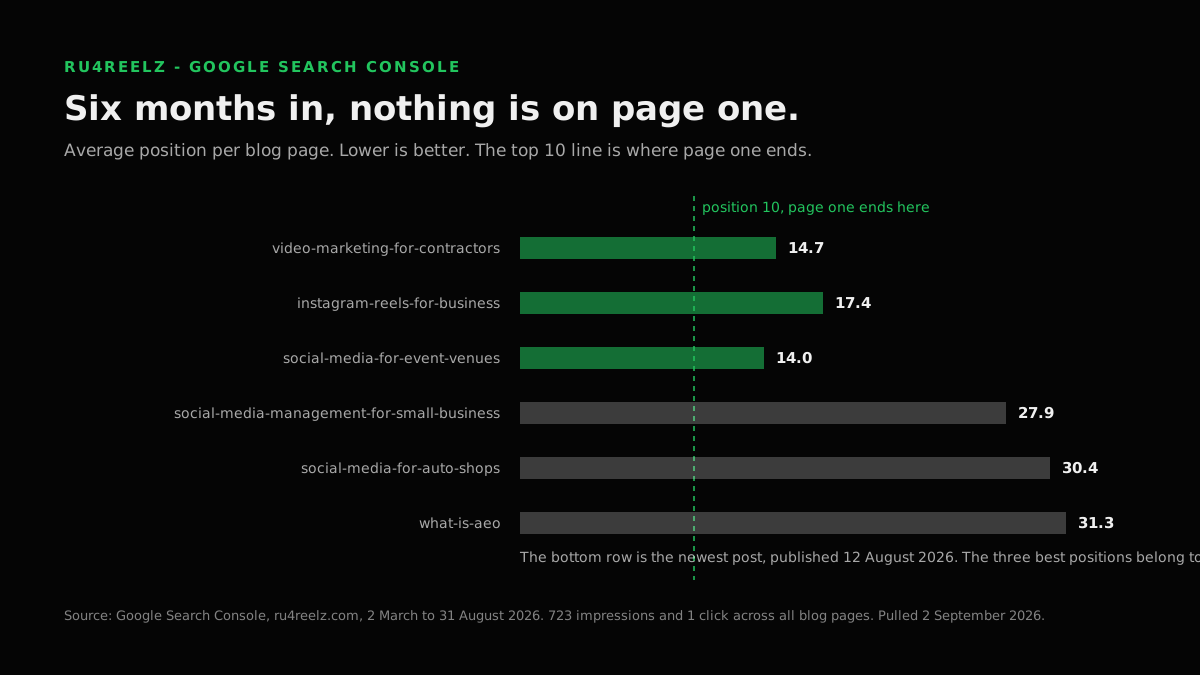
Look at the order though. The five posts holding my best positions are the oldest ones on the site. My newest, published on 12 August, sits at 31.3. That is the same pattern the Ahrefs data describes, showing up on a domain with six posts and no authority to speak of.
I want to be straight about the limits of that. Six posts on one small site is not a controlled test. The topics are different, the competition is different, and older posts have simply had more chances to be seen. It is consistent with the research rather than evidence for it. But it is my real data, and it is what six months actually looks like.
The number that matters is how old the page is
The ranking timeline is the question people ask. The age data is the answer they need. Ahrefs looked at 1.3 million random US keywords and found that 72.9 percent of pages in the top 10 are more than three years old, up from 59 percent in 2017. Only 13.7 percent were under a year old, down from 22 percent. The authors flag that some of that difference could come from how the data was sampled, and I am repeating the hedge because they wrote it.
The figure that reframed this for me: the average number one ranking page in Google is 5 years old. In 2017 it was 2 years old.
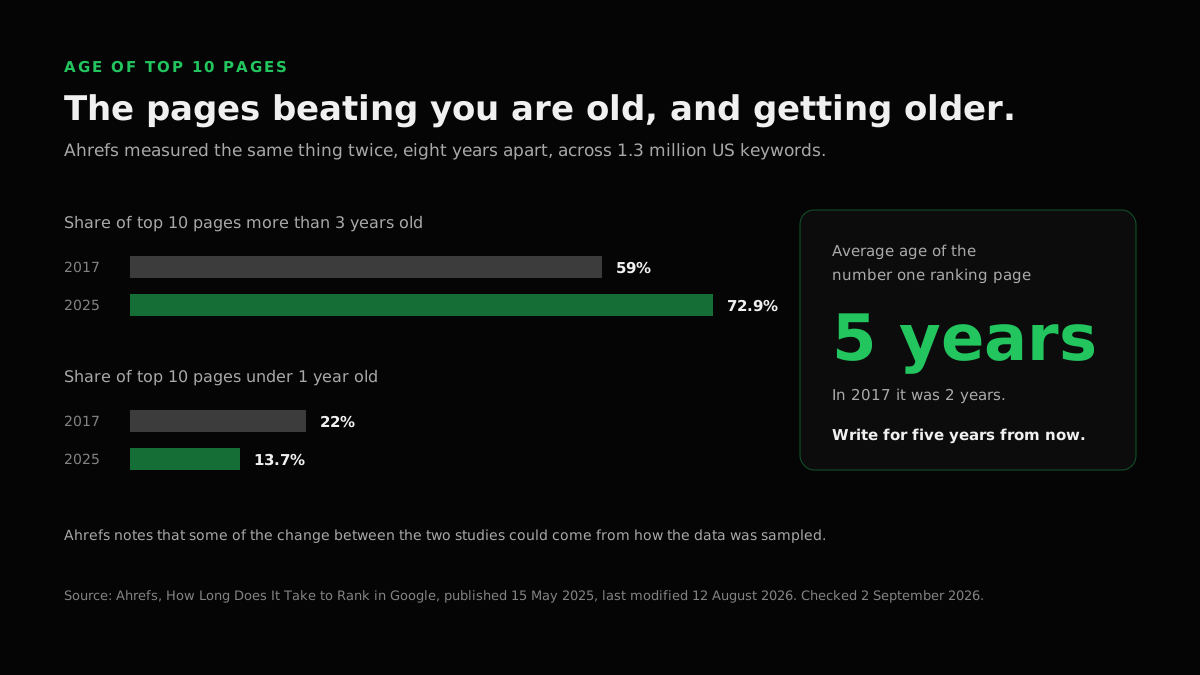
That changes what you should publish rather than how long you should wait. If the page that eventually wins is five years old, it has to still be true in five years. Something assembled from other blogs is stale inside a year, as the 5.7 percent example at the top of this article shows. That is the whole argument for building fewer pages and sourcing every claim in them, which is what I do when I write an authority blog for somebody.
The one thing I could not verify
Whether 1.74 percent and 6.11 percent are directly comparable. They use different months, September against October 2023, different sample sizes, 1 million against 2 million, and different filters. Ahrefs does not publish the overlap between the two, so I cannot tell you that 6.11 percent is the same measurement cleaned up. I think it is the better figure to use for a real business page, and I cannot prove it is a like for like recalculation. If Ahrefs publishes the breakdown, I will update this section.
Should you start a blog if you need customers this quarter?
No. Run ads. 98.26 percent of new pages did not reach the top 10 within a year, and my own best post is on page two after six months. Nothing about that fills your calendar in March.
Ads buy speed and stop the day you stop paying. A blog post is slow and does not switch off. They are different tools and the mistake is expecting one to do the other's job. If your problem is this quarter, this is not the answer to it.
What I would do if this were your site
- Pick questions your customers actually ask you on the phone, not keywords from a tool. Low volume and answerable beats high volume and generic, because the data shows high volume terms take longer and 94 percent of pages never rank for them at all.
- Write fewer pages and source them properly, since the page that wins is likely to be years old and has to survive that long.
- Check at six months. If a post has no impressions by then, update it rather than waiting, which is what the study recommends.
- Fix the technical floor first. A page nothing can crawl will not rank at any age, and that is ordinary local SEO work rather than content work.
- Measure impressions before clicks. Impressions tell you Google is showing the page. Clicks come later and mine mostly have not arrived yet.
One more thing worth knowing. Google is not the only surface any more, and the timelines are not the same. I ran that test on my own business separately and wrote up what AEO means for a local business, including the run that went worse. If your site is not crawlable in the first place, none of this applies yet, and local SEO is the thing to fix before you publish anything.
Common questions
How long does it take for a blog post to rank on Google?
For most pages it does not happen at all. Ahrefs found 1.74 percent of newly published pages reached the top 10 within a year, rising to 6.11 percent when filtered to real English content. Of the pages that did rank, 40.82 percent got there within the first month, so a page still invisible at six months usually needs changing rather than more patience.
Can anyone tell me exactly when my blog will rank?
No. There is no number anyone can honestly give you, because it depends on your site, your topic and your competition. What the data does support is a range and a decision point: check at six months, and if there are no impressions by then, update the post instead of waiting for it to improve on its own.
Is 1.74 percent the right number for my business?
Probably not. That figure comes from random crawled URLs, which includes parked domains and empty pages. Ahrefs ran the same study restricted to non-empty English content and got 6.11 percent, and said that might be the fairer number. A real article on a real business site belongs in the second group.
Do older pages really rank better than new ones?
The correlation is strong. Ahrefs found 72.9 percent of top 10 pages are more than three years old, and the average number one page is 5 years old, up from 2 years in 2017. Age is not a ranking factor by itself, but it stands in for accumulated links, updates and trust that a new page has not had time to build.
How many blog posts do I need before anything happens?
Volume is the wrong target. My site has six posts with data and 723 impressions across six months, and the oldest ones perform best regardless of how many sit beside them. Publishing twenty thin pages does not shortcut the timeline. Fewer pages that stay accurate for years is the approach the age data supports.
Should I delete a post that has not ranked?
Update it before you delete it. Ahrefs recommends looking at the content after roughly six months without a top 10 position, because the odds of improvement without changes are low from that point. Deleting removes any chance of the page maturing, and a rewrite is usually cheaper than starting a new page from zero.
Does a blog still matter if people are asking AI assistants instead?
It matters differently. An assistant has to find something accurate to quote, and a well sourced page is what it quotes. The timelines are not the same as Google's, and I tested that on my own business and published both runs including the worse one. Neither surface rewards content assembled from other blogs.
Why does every article give a different answer to this?
Partly because they measure different things, and partly because old figures keep circulating. One page ranking for this question in April 2026 still publishes 5.7 percent and a 950 day page age, which are the 2017 numbers. Ahrefs updated the study in May 2025. Check the date on any figure before you plan around it.
Related on this site
- Authority blogs what it costs to have one of these written properly, and what goes into it
- What AEO means for a local business the same test run on AI assistants instead of Google, both runs published
- Local SEO the technical floor underneath any of this working
- AI search optimization the other surface your pages need to be found on
- Pricing everything I charge for, in one place
Sources
- Ahrefs: How Long Does It Take to Rank in Google, and How Old Are Top Ranking Pages, May 2025
- Ahrefs: the original 2017 study these figures superseded
- Ahrefs: 107 SEO Statistics for 2026, which lists the headline figure without the caveat
- Content Powered: an April 2026 article still publishing the superseded 2017 numbers
- Google Search Console Help: how average position is calculated
I film reels for local businesses in LA and Orange County
On site filming, same day editing, posted across four platforms. If you want to talk through what that would look like for your business, call me.