AI SEARCH
What AEO Means for a Local Business, and What It Does Not
Short answer
AEO means answer engine optimization. GEO means generative engine optimization. Google's own documentation names both and says that for Google Search this is still SEO rather than a separate discipline. Outside Google the terms get used differently, and plenty of pages insist they are distinct. Either way the controllable parts are crawlability, real text, and consistent business details.
On 11 August 2026 I asked ChatGPT to find the best Reels content creator for a business in Los Angeles. I ran it twice on the same day, in temporary sessions so nothing was personalised to me. It named my business both times.
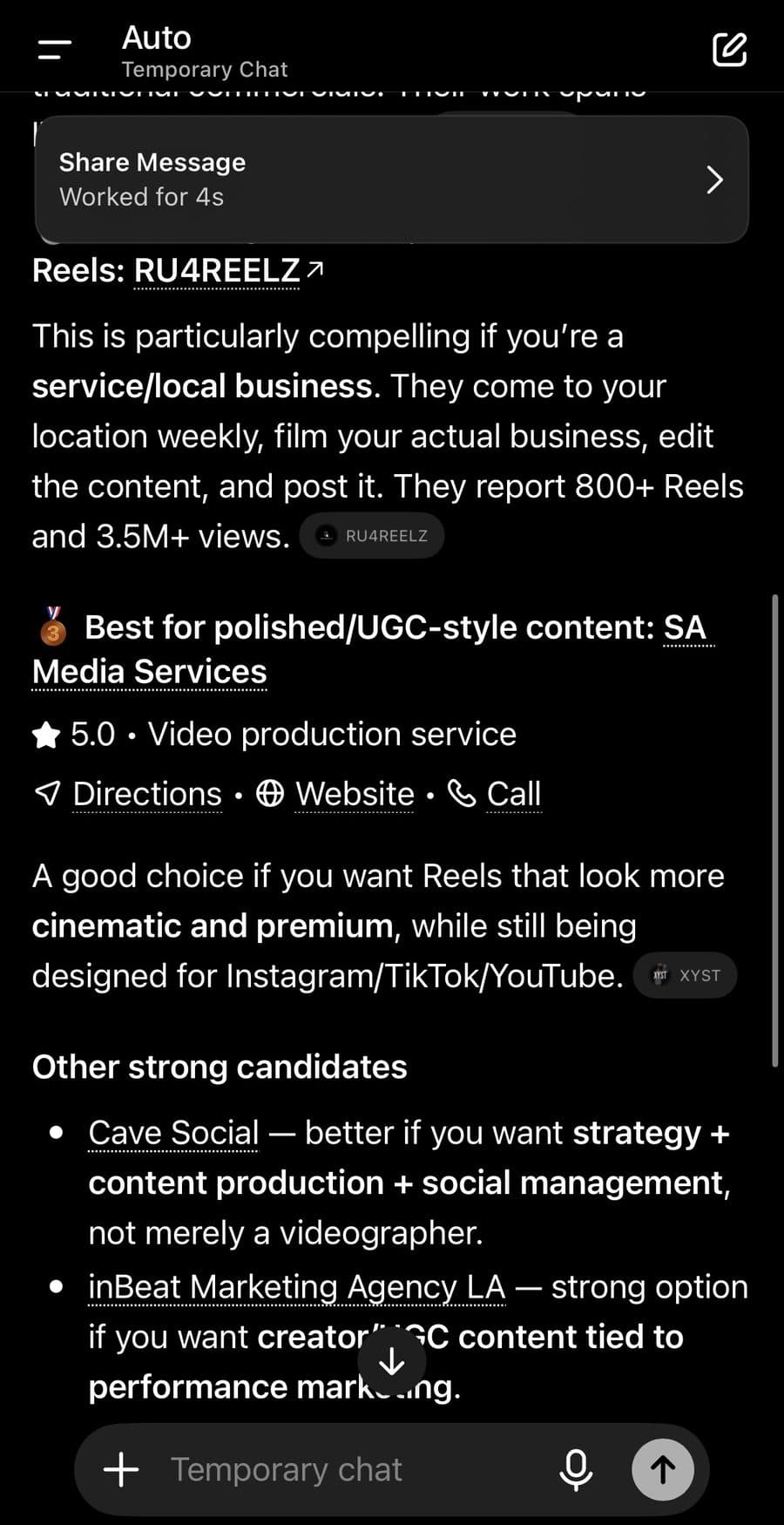
Second out of five in the first run. Fourth out of five in the second, though it was also one of only two final picks. The position moved, and the assistant resolved my location differently the second time.
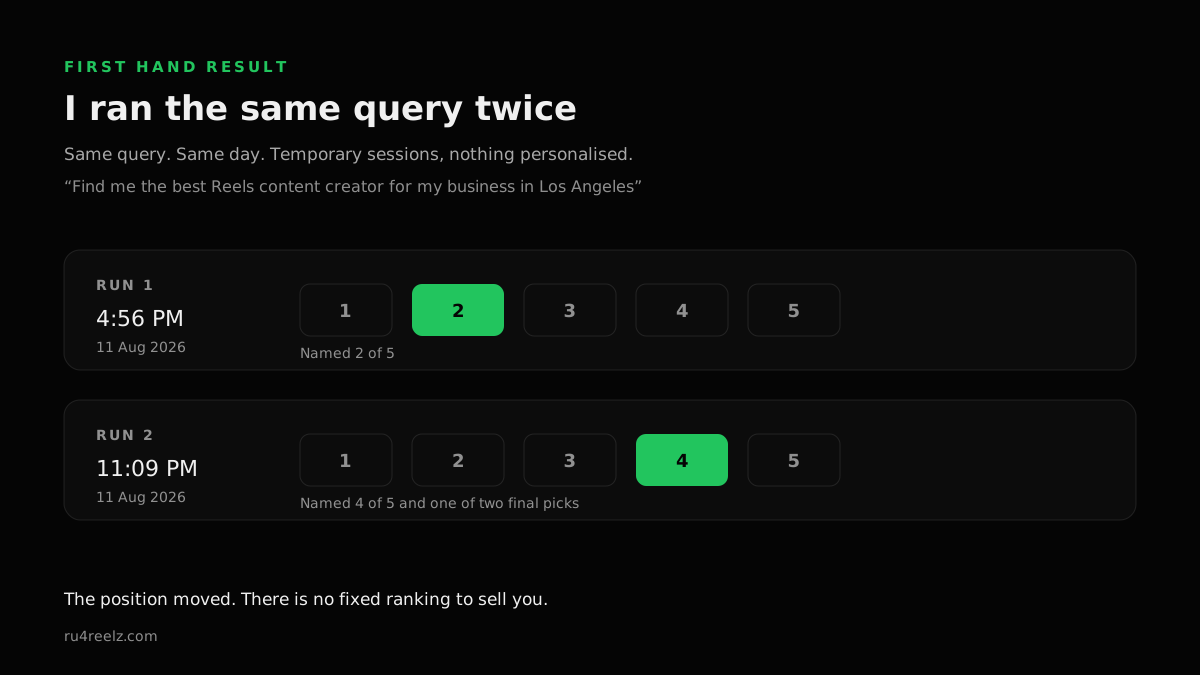
I am telling you that up front for two reasons. One, almost everyone selling AEO right now has never tested it on their own business. Two, the movement between those two runs is the single most important thing to understand about this whole category, and it is the part the sales pitches leave out.
What does AEO stand for?
AEO means answer engine optimization. You will also see GEO, AI SEO and LLM SEO. Somebody will eventually try to sell you all four as separate disciplines with separate invoices.
| Term | Stands for | Where it came from |
|---|---|---|
| AEO | Answer engine optimization | Marketing industry, no single origin |
| GEO | Generative engine optimization | Academic paper, KDD 2024 |
| AI SEO | AI search engine optimization | Marketing industry |
| LLM SEO | Large language model SEO | Marketing industry |
Four names, and whether they describe one job or four depends entirely on who you ask.
Google answers it directly. Its guide to optimizing for generative AI features on Search carries a section headed with exactly this question, what about AEO and GEO. It names both, says they are terms people use for work aimed at visibility in AI search, and says that from Google Search's perspective this is still SEO. That is Google's own documentation, published 15 May 2026 and last updated 10 July 2026.
Read the scope on that, though. Google said from Google Search's perspective. Google is talking about Google. ChatGPT and Perplexity are not Google Search, and Google takes no position on them because they are not Google's products. The test further down this page was run on ChatGPT, so that guidance does not settle it.
GEO is the only one with a real origin. Researchers published a paper titled GEO: Generative Engine Optimization, first posted in November 2023 and accepted to the KDD 2024 conference. That paper coined the term. Everything else in the category is downstream of it.
Plenty of pages will tell you the two are separate disciplines with different goals and different tactics. Google's own AI Overview does, on the query aeo vs geo, citing a Reddit thread and a marketing blog rather than the Google documentation above. I am pointing at that disagreement rather than pretending to settle it. The labels are contested. The work underneath them is not, and it is the same work I describe on the AI search optimization page whatever you decide to call it.
Does AEO actually work, and by how much?
The paper introduced a benchmark called GEO-bench and tested whether content could be deliberately changed to appear more often inside AI generated answers. The headline result is that the methods boosted visibility by up to 40 percent.
Read that carefully, because the sales version drops two words. Up to. It is a ceiling observed in a controlled benchmark. It is not an average, and it is not a forecast for your website.
The same paper reports that how well these methods work changes by domain, and concludes that domain specific approaches are needed. That is researchers politely saying there is no universal playbook.
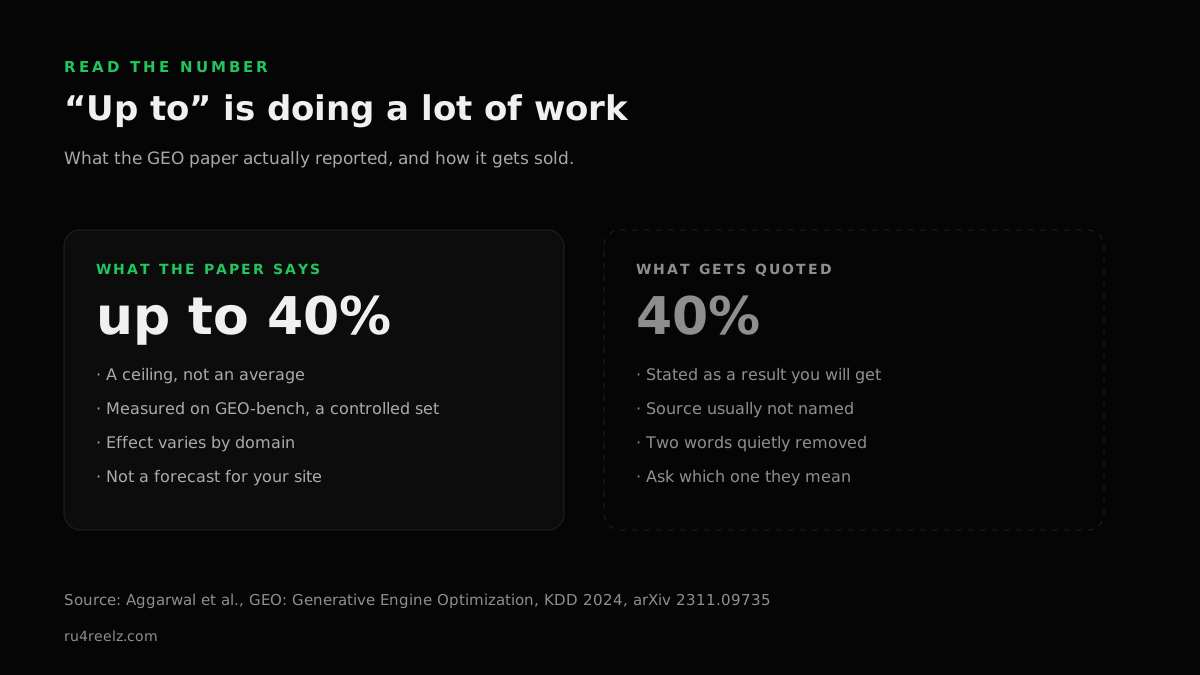
So when somebody quotes you 40 percent as the number they will hit for your business, they either have not read the paper or they are betting that you have not.
Why does my position keep changing?
Because there is no fixed position. This is the thing my own two runs demonstrate better than any argument.
Ask the same question twice and you can get a different order, a different set of businesses, and a different read on where you are. In my second run the assistant placed my location somewhere other than where I had asked about, which changed the whole answer.
There is also lag. About 100 minutes after I pushed updated figures to my own site, ChatGPT was still quoting the older numbers from an earlier crawl. What the model says about you today may reflect a version of your site from weeks ago.
The practical consequence: anyone promising you a ranking in AI search is selling something that does not exist. The realistic goal is being named often, described accurately, and cited from a source you control.
Google's own advice is boring, and that is the point
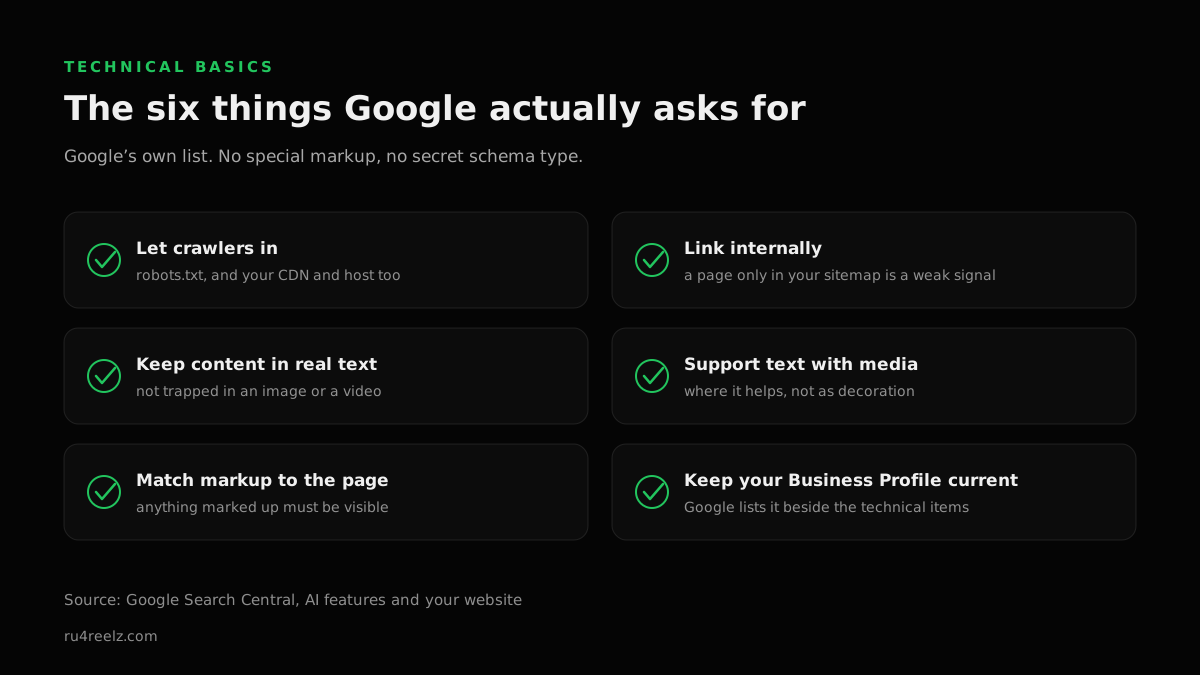
Google's own guidance is refreshingly boring, which is usually how you know it is honest. The things it lists are these.
- Let your pages be crawled. Not just in robots.txt, but at your CDN and your host too. Plenty of small business sites quietly block crawlers at the infrastructure layer and nobody ever checks.
- Make pages findable through internal links on your own site. A page reachable only from your sitemap is a weak signal.
- Keep important content in real text. If your services, service area, or hours exist only inside an image or a video, that information is not there as far as a machine is concerned.
- Support the text with good images and video where it helps, rather than as decoration.
- Make your structured data match what a visitor actually sees. Google is explicit that markup content has to be visible on the page.
- Keep your Google Business Profile current. Google lists it right alongside the technical items.
One more that people miss. Google says restrictive snippet settings will limit how your content appears in its AI experiences. If someone once capped your snippet length to protect your content, that decision is now working against you.
Google also closes its guide by saying you do not need to do everything in it to succeed, and that plenty of content does well in Search, including the AI experiences, without any overt SEO at all. That is a strange thing for a vendor to quote at you, which is exactly why I am quoting it.
How do I know if AEO is working?
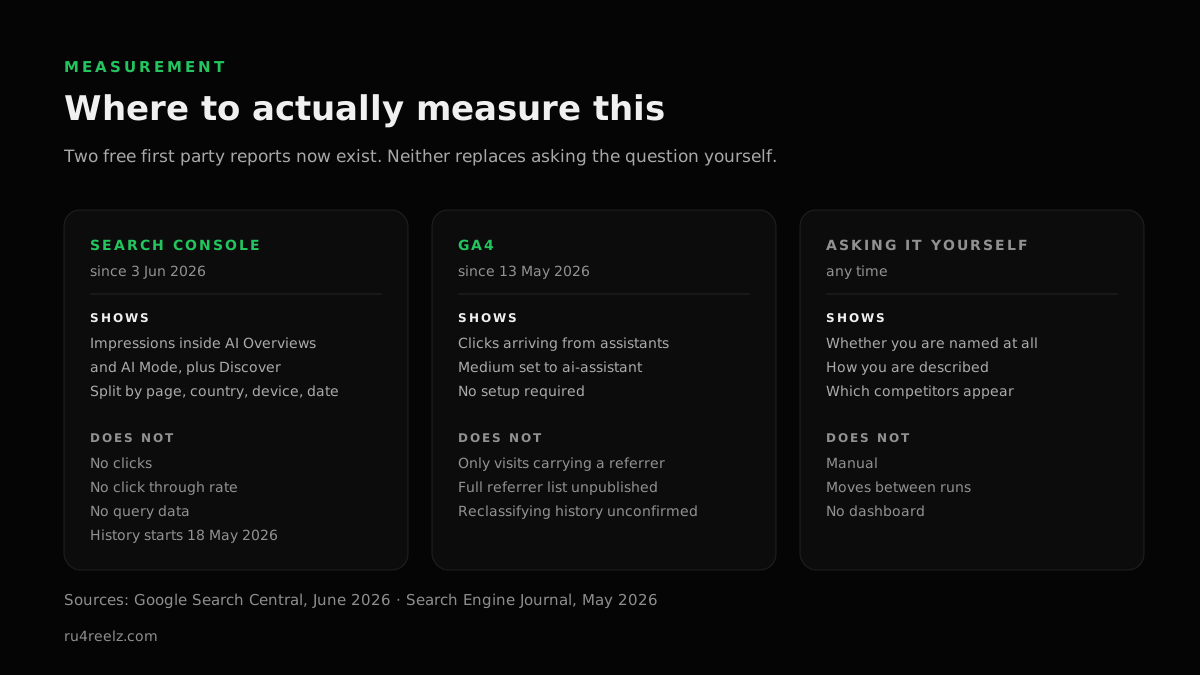
This part changed recently, and it changed in your favour. There are now two free first party places to look, and one manual check that still matters more than either.
Search Console, since June 2026
On 3 June 2026 Google launched Search Generative AI performance reports in Search Console. For the first time you get a dedicated view of your impressions inside generative AI features on Search, meaning AI Overviews and AI Mode, plus generative AI in Discover. Google was clear that this is not new data. Those impressions were always inside your overall performance totals and still are. What is new is being able to see them on their own.
Know the limits before you get excited. It reports impressions only. No clicks, no click through rate, no query data. It breaks down by page, country, device and date. Data starts on 18 May 2026, so there is no earlier history, and access rolled out to a subset of site owners before going wider.
GA4, since May 2026
On 13 May 2026 Google Analytics 4 added an AI Assistant channel to its default channel group. When a visit arrives from a referrer Google recognises as an AI assistant, it sets the medium to ai-assistant and files the session under that channel. No setup, no regex, no burning one of your two custom channel slots.
Two honest caveats, because the reporting on this does not agree with itself. Google has named ChatGPT, Gemini and Claude as examples but has not published the full list of recognised referrers, so coverage disagrees on whether Perplexity is in there. And Google has not explicitly confirmed whether the change reclassifies your older traffic or only counts forward, which decides whether your month over month comparison across mid May means anything.
What is not in dispute: it only sees visits that arrive carrying a referrer. Anything that arrives without one still lands in Direct, and a lot of AI traffic does. Treat the number as a floor.
Both of these are free and first party, which is a much better argument against buying a third party AI visibility dashboard than the one I would have made a year ago.
The check that still matters most
Beyond the dashboards, the honest measure is repetition. Ask the questions your customers would ask, on a schedule, keep the screenshots, and watch whether you start getting named. That is slower and less satisfying than a number on a slide, and it is the only thing that tells you something real. It is what I did to myself, and it is why I can show you two runs instead of a claim.
Where I would start if this were your site
Open your site on your phone and read it like a stranger. Can you tell what the business does, where it works, and how to reach it, in real text, in the first screen? If not, fix that before anything else.
Then check your pages return properly and are not blocked anywhere in the stack. This overlaps almost entirely with ordinary local SEO, which is the point.
Then make your structured data describe the same business as your visible page, with the same name, address and phone number as your Business Profile. Mine, so you can check I follow my own advice: RU4REELZ, 17434 Bellflower Blvd Suite 200-270, Bellflower CA 90706, (562) 579-9445.
Then go ask an assistant the question your customers would ask. Run it more than once. Screenshot what comes back, including the runs where you do not appear. Mine are here, the bad one included.
Common questions
Is AEO different from SEO?
Not meaningfully. Google frames succeeding in its AI features as an extension of ordinary search work and says there is no special markup for it. The emphasis shifts toward being clearly readable and quotable rather than toward ranking a link, but the underlying work overlaps almost completely.
Does schema markup get me into AI answers?
It helps machines understand your page, and Google recommends it. It does not guarantee anything, and Google is explicit that anything in your markup must also be visible to a visitor. Marking up claims that do not appear on the page works against you.
How do I check whether AI tools mention my business?
Ask them directly, using the question a customer would ask, more than once, and screenshot the results. On the Google side, use the Search Generative AI performance report in Search Console for impressions inside AI Overviews and AI Mode, and the AI Assistant channel in GA4 for clicks arriving from assistants like ChatGPT. Remember GA4 only sees visits that carry a referrer, so treat it as a floor.
Can anyone guarantee me a position in ChatGPT?
No. My own two runs on the same day produced different positions and a different location read. There is no stable ranking to sell you.
How long does AEO take to work?
Nobody can tell you honestly, because it depends on how crawlable your site is now, how much real text is on it, and how well known your business already is. There is also crawl lag. After I updated my own figures, an assistant was still quoting the old ones about 100 minutes later.
Is the 40 percent figure real?
It comes from a real peer reviewed paper, but it is an upper bound from a controlled benchmark, not an average and not a forecast. The same paper reports that results vary by domain.
What should a local business do first?
Read your own site on your phone like a stranger and check that what you do, where you work, and how to reach you are all in real text on the first screen. Then confirm nothing in your stack is blocking crawlers. Then make your name, address and phone match between your site, your structured data and your Google Business Profile. Then ask an assistant the question your customers would ask, more than once, and screenshot it. Everything else is downstream of those four.
Do I need to pay for an AI visibility tool?
Probably not to start. Since June 2026 Search Console reports AI feature impressions on its own, and since May 2026 GA4 separates AI assistant referrals. Both are free. Exhaust those before you buy anything.
Related on this site
- AI search optimization what this looks like as a service
- My ChatGPT results dated screenshots from both runs, including the worse one
- Local SEO the fundamentals underneath all of this
- Google Business Profile the profile Google explicitly tells you to keep current
- Pricing what I charge
Sources
- GEO: Generative Engine Optimization, Aggarwal et al., KDD 2024
- Google: Introducing Search Generative AI performance reports in Search Console, June 2026
- Google: Top ways to ensure your content performs well in AI experiences
- Google Search Central: AI features and your website
- Google: guide to optimizing for generative AI features on Search
- Search Engine Journal: Google Analytics adds AI Assistant as a default channel group, May 2026
I film reels for local businesses in LA and Orange County
On site filming, same day editing, posted across four platforms. If you want to talk through what that would look like for your business, call me.